
Life In Color: Meet SBMA Director Amada Cruz
Director of the Santa Barbara Museum of Art, Amada Cruz, brings a lifetime of resilience and curiosity to her work. In her home office, she reflects on the moments and mentors that shaped her path.
By Maddy Sims
Photography Silas Fallstich
Most museum directors chase polish: quiet rooms, white walls, a kind of reverent perfection. Amada Cruz does not. “We tend to strive for perfection in museums,” she says. “But life isn’t perfect.” Her mission as the Eichholz Foundation Director and CEO of the Santa Barbara Museum of Art is simple: to make the museum feel more approachable, more alive, more human.
To Cruz, success is measured in energy—children squealing, friends laughing, bursts of color and texture at every turn. “I want everyone to feel welcome at the museum,” she says. “I want everyone to feel like the SBMA is for them.” It’s an unusual approach, but Cruz’s path is far from typical.

She arrived at NYU intending to pursue law. But after working in law firms, she realized it wasn’t her path and pivoted to art history. “When I mentor young people, I tell them it’s just as important to find out what you don’t like,” she says. “It’s not a failure.”
Switching from law to art, especially as the child of immigrants, was a leap. “I feel really lucky that I was supported in this decision,” she says. “But working was always important in my family. You had to be committed. There was no slacking off, even if I was going into the arts.” Her upbringing not only instilled a fierce work ethic, but also a natural embrace of change. “For some people, it’s jarring,” she says. “But for me, change is part of life. Growing up, we moved around. Coming from an immigrant family, you take opportunities where you find them.”
Her first foray into the art world was an unpaid internship at the Guggenheim, where she did everything from drafting letters to giving public tours. “I was working for free, but I loved it,” she says. “I did whatever the curator asked.”
Across her career—from Chicago to Phoenix to Seattle—Cruz’s hallmark has been adaptability. She’s collaborated closely with living artists, reimagined programming, expanded outreach to diverse communities, and even led the Seattle Art Museum through a global pandemic. Advising on artist grants taught her about fundraising. Moving across the country opened her eyes to all kinds of art. “When faced with a challenge, I have so many reference points,” she says. “It’s a gift.”
One of the most formative reference points arrived early: her friendship with Félix González-Torres. As a young curator, Cruz admired minimalism, but González-Torres gave it an unexpected emotional charge. “He would take reduced forms in simple geometric shapes and infuse them with life, with content about the human experience,” she says.
She recalls one work in particular: two stacks of white paper, one labeled “Somewhere better than this place,” the other “Nowhere better than this place.” “It was elegant and pure, but it was about content, about life, about making choices,” she says. “It was participatory. It was very human. That work was revelatory to me.”
The lessons extended far beyond aesthetics. “Because he was sick with AIDS, I think about the things I learned from him in terms of being rigorous and trying to do the best all the time,” she says. “He taught me to take advantage of the now and to spend time with friends and family, because we don’t know what tomorrow will bring.” A black-and-white photograph of his hangs above her fireplace. “I see it every day,” she says, her eyes softening.
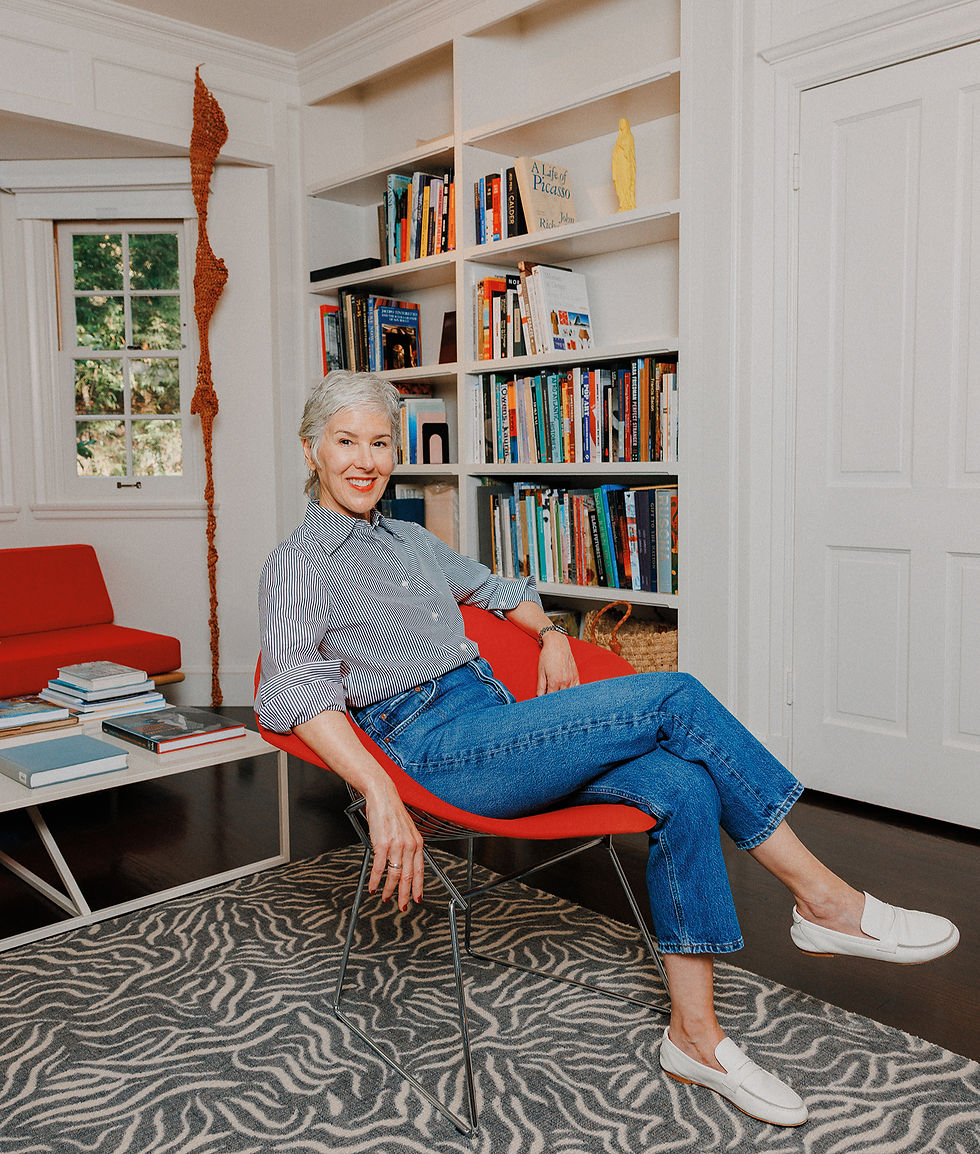
Her home office is an intimate collage of her own history. Warm and densely layered, it feels more like a lived-in studio than a workspace. Shelves overflow with art, travel, and fiction books. Small mementos—souvenirs, photographs, artworks—are scattered about, each with its own story. One framed newspaper clipping captures her mother scolding Andy Warhol at a book signing. Nearby sits the signed book itself, complete with Warhol’s humorously long inscription. The room, like its occupant, radiates life.
When Santa Barbara called, they wanted transformation. Cruz has delivered. “It’s been fun thinking about how to make a space active and energized, especially in galleries that are typically still,” she says. Color has become one of her favorite tools. “There are some paintings that really pop when they’re against intense blues and greens,” she says. She and her team have also been mixing media—paintings beside photographs, sculptures beside posters. “People expect easel-size paintings on white walls,” she says. “We want surprises.”
Even the classical sculpture galleries have begun to shift. Traditionally presented as pristine marble, these works were once vividly painted. Cruz wants visitors to see them as the ancient Greeks and Romans did: animated and intertwined with everyday life. And then there is the unmistakable magnetism of originals. “We have four Monet paintings,” she says. “If you want to see them, you have to come. They just don’t reproduce the same way on a screen.”
This winter’s major Impressionist exhibition (on display through January 22) feels like the purest expression of Cruz’s ethos. The Impressionists, she says, were once considered rebellious—too loose, too raw, too unfinished. Their work pushed back against academic perfection, making art feel immediate and alive. “I would love for people to understand how revolutionary that work was at the time,” she says. “This idea of artists expressing themselves the way they want—we still live in that world. And it started with the Impressionists.”

Cruz has infused SBMA with that same spirit. Real life belongs in the museum: families, students, neighbors. The community, she believes, should shape the institution as much as the art on its walls. With Santa Barbara’s population nearly half Latinx, one of her early decisions was reinstating bilingual signage. “It’s like a welcome mat. It says, ‘We know you’re here, and this place is for you,’” she says.
Having spent her childhood in museums, Cruz is also passionate about helping children discover art. One example is a partnership with local schools where teachers who are practicing artists guide students in seeing and making art. 25,000 students and teachers participated last year. She plans to grow the number. At the museum, the new Art Learning Lab invites visitors of all ages to create work inspired by the galleries.
Reflecting on her journey, Cruz shares what she wishes she could tell her younger self: “Everything is going to be fine,” she says. “Take it one day at a time. Do your best. Love your family and friends. Don’t lose sight of being present with the people around you.” It’s advice that echoes her philosophy for the museum itself: slow down, embrace imperfection, make room for connection.


Comments