
Rooted in Tradition
Founded in 1985 on a historic Santa Barbara County ranch, Foxen Wines has grown from a small operation into one of the region’s most respected producers. Now the next generation is carrying the winery forward while staying rooted in its family-driven philosophy.
By Maddy Sims
Photography Silas Fallstich
The drive to Foxen Vineyard is a journey back to an earlier California. Past the familiar storefronts of Los Olivos, the rustic back road winds through rolling hills dotted with sprawling oak trees, grazing cattle, and horses scattered across golden grass. By the time you turn onto Foxen Canyon Road, cell service has nearly disappeared. It’s peaceful out here.
At the end of the road sits Foxen Vineyard, overlooking rows of vines from its modern tasting room. Just beyond it stands the winery’s original home: A weathered tasting room affectionately known as “the Shack,” which opened in the 1980s, and the Wickenden House, the original family home dating to 1837. Together, they tell the story of one of Santa Barbara County’s original wine families.

Foxen was founded in 1985 by Dick Doré and his friend, winemaker Bill Wathen, on Rancho Tinaquaic, the family ranch first purchased in 1837 by Doré’s great-great-grandfather, William Benjamin Foxen. Doré had fallen in love with wine while traveling through Europe, and Wathen was eager to make his own. They partnered up and began Foxen.
The winery’s first days were anything but polished. “In the beginning it was scary,” Doré says. “We were using borrowed equipment and did our first crush on my basketball court at the Rancho Tinaquaic. We didn't have a forklift and had to do our first press in the back of a pickup truck.”


Four decades later, Foxen has grown into one of Santa Barbara County’s most respected wineries, but its philosophy has remained remarkably intact. “We have always seen ourselves as farmers first,” Doré says. “With Billy's background as a viticulturist, we have been able to access Santa Barbara County's finest vineyard sites. And our goal in winemaking has remained consistent for the last 40 years—to make balanced wines that express their sense of place.”
That philosophy is now being carried forward by a second generation. Kaitlin Armstrong (Doré’s stepdaughter) leads sales and marketing, Riley Wathen Slack oversees operations and finance, and Bingo Wathen has taken over winegrowing and vineyard management (Bill Wathen is still the head winemaker, but they act as a team). For Doré, it is exactly the future he hoped for. “Now that I'm an old fart, it’s my hope that the next generation of both our families, who have stepped up in the last few years, are able to continue the Foxen tradition of making great wines,” he says.

This generation isn’t reinventing Foxen, they’re building on what already exists. The tasting room overlooking the vineyards opened in 2009, replacing the original (though the Shack still operates on weekends for visitors who want to see where it all began). “Our original tasting room started in 1985,” Armstrong says. “Dick and Bill were running the whole business themselves and ran it in a very casual way. They make serious wines, but don’t take themselves too seriously, which is the basis for the Foxen brand. We’ve carried that ethos as we have expanded over the years.”
We walk through the property’s winemaking and storage facility: Cool, cavernous rooms lined with barrels, built to support a much larger operation than the original setup. “We built this facility out of necessity to grow the business,” Armstrong explains. “Our old winemaking facility was a barn outside—no temperature control, no air conditioning. We were fermenting the wines in open-top fermenters with tarps over them, with bungee cords. It was very primitive in that way, but it helped us refine our winemaking.”
Throughout the property, the past remains present. Armstrong recently introduced new wine labels, but instead of starting over, she updated a design her mother originally created decades ago on Microsoft Word. “I wanted to preserve our history and modernize it a little bit,” she says. The anchor featured on every bottle is more than a logo. It was once the cattle brand of William Benjamin Foxen, the English sea captain who settled in Santa Barbara in 1836 after marrying a local Mexican woman and purchasing Rancho Tinaquaic.
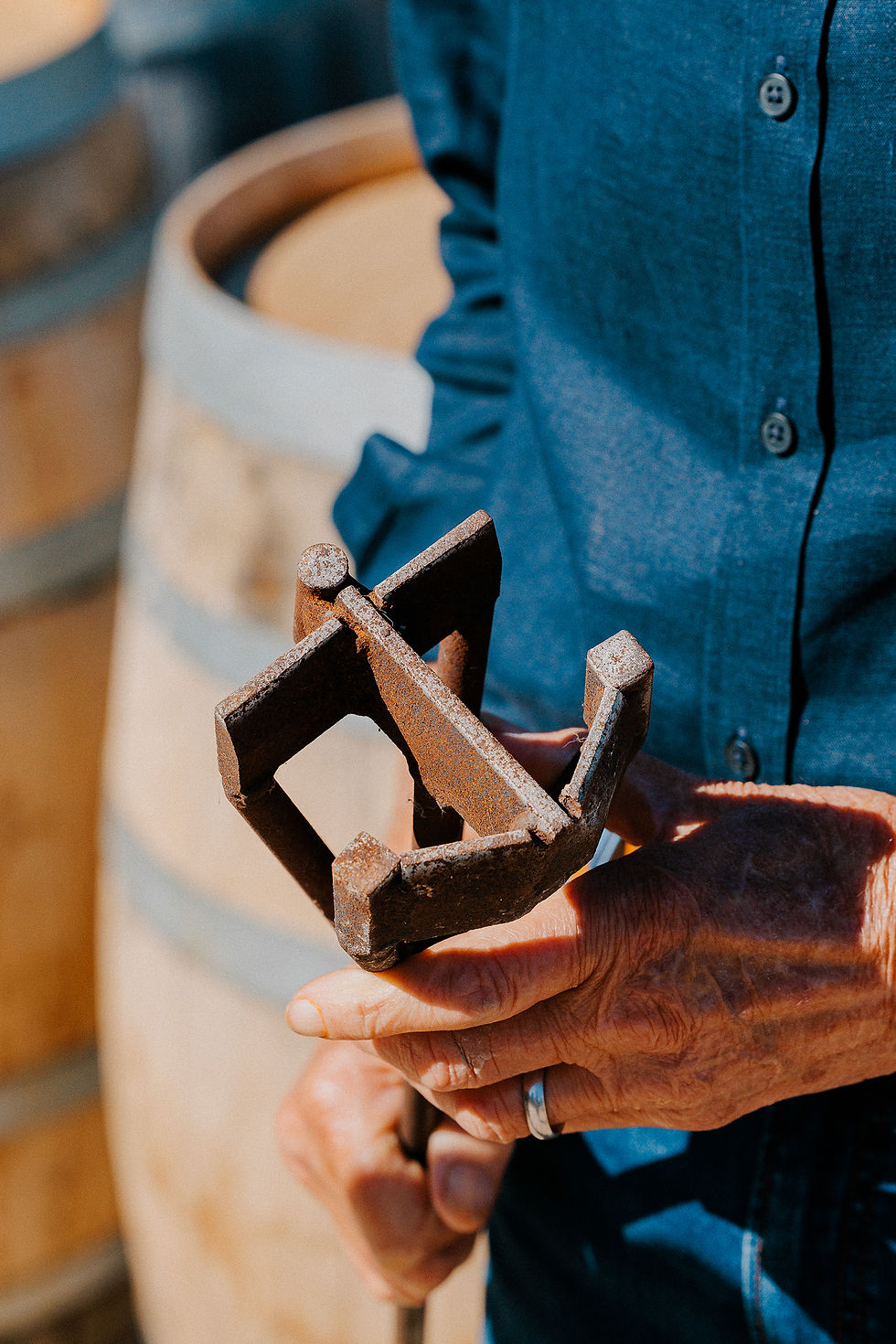
“It’s one of the original ranches of California,” Armstrong notes. That history extends beyond the label. Just down the road, the original family home still stands. “That’s the house that my stepdad grew up in, his mother grew up in, his grandmother grew up in, and it's the first wooden structure in Santa Barbara County,” Armstrong says. “The furniture inside came over from England in 1836.”
That commitment to preserving the past extends into the land itself. One of the winery’s longest-standing practices began with a simple limitation: There was no water. When Dick Doré and Bill Wathen planted their hillside vineyard in 1989, irrigation wasn’t an option, so they dry farmed instead—a practice that continues today. Foxen remains one of the only wineries in Santa Barbara County to dry farm its estate vineyards entirely.
“We don't give the plants any water whatsoever,” Armstrong says. “It's a difficult way to farm.” The payoff comes in the glass. Without irrigation, the vines produce fewer, smaller grapes with concentrated flavor rather than dilution. Cover crops, fruit trees, and grazing lambs help maintain biodiversity and soil health. “It’s a labor of love,” Armstrong says. But it’s worth all the work: The dry-farmed chardonnay is some of the best I’ve tasted, bursting with flavor and complexity.

Yet not all Foxen wines are dry farmed. “We wouldn't be making any money if we only dry farmed,” she adds with a laugh, so they work with growers across the region to build out the rest of their production. Since the beginning, Foxen has resisted defining itself by a single appellation. Instead, it looks across Santa Barbara County, sourcing fruit from vineyards stretching from the fog-shrouded Sta. Rita Hills to the warmer slopes of Happy Canyon and the sandy soils of the Santa Maria Valley. “We're a Santa Barbara County producer,” Armstrong says. “We're going to take what we find to be the best of each AVA.”
It's an approach that's only possible because of Santa Barbara County's remarkable geography. Unlike most California mountain ranges, the region's mountains run east to west, drawing cool Pacific fog deep inland. The result is an extraordinary range of growing conditions packed into a relatively small area, allowing Pinot Noir, Chardonnay, Rhône varieties, Bordeaux grapes, and even Italian varietals to thrive within the same county.
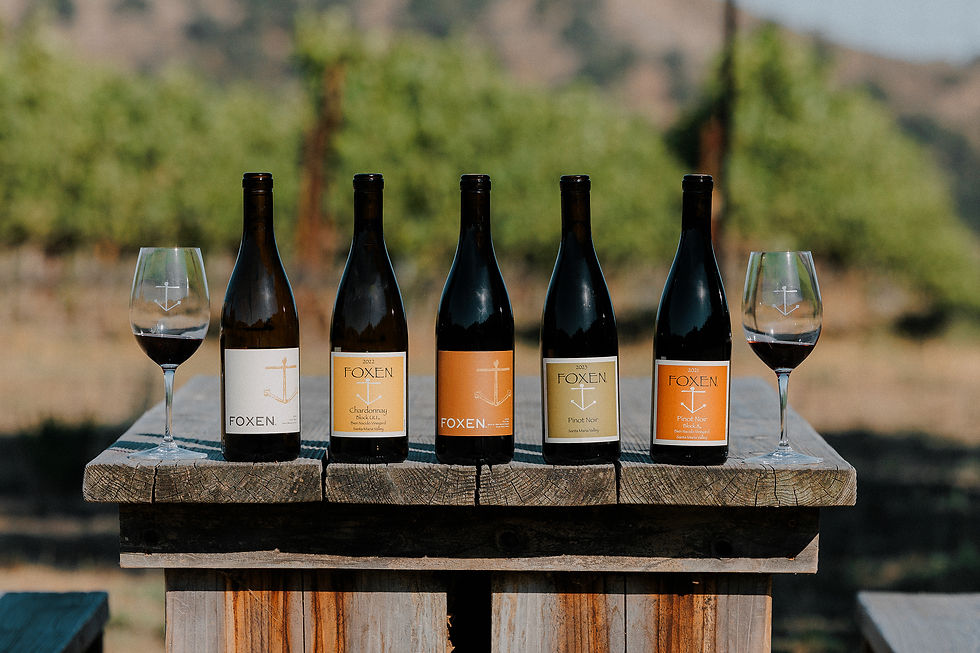
The winery embraces that diversity rather than narrowing its focus. Today, Foxen produces nearly 30 different wines, many of them single-vineyard bottlings designed to showcase the character of one specific place. “These are what we call terroir-driven wines,” Armstrong says. “When you open a bottle of John Sebastiano Vineyard from Sta. Rita Hills, we want it to taste like Sta. Rita Hills fruit. We want it to showcase what that area tastes like.”
Foxen offers a collection of wines that reflect the remarkable range of Santa Barbara County itself. For Armstrong, that connection to place is deeply personal. She grew up in Santa Barbara County surrounded by wine. Her mother worked in the industry before marrying Doré, and although Armstrong spent time living elsewhere, she found herself drawn home. Now, alongside Riley Wathen Slack and winemaker Bingo Wathen, she's helping lead Foxen into its next chapter. “It’s a tradition for wineries to be passed into families, and we're lucky that we’re able to do that,” she says. “A lot of people start a winery, and they end up selling it. We're grateful that we've been able to keep it within our family. I think it gives it a different meaning, having that strong family tie.”
The next chapter is already unfolding. Foxen has introduced redesigned labels, modernized packaging, and digitized decades of handwritten records, all while keeping its original identity intact. “It’s important for us to take what our families built and continue it on and try not to screw it up,” Armstrong jokes. “We want to preserve that history and then also innovate in new ways to expand things and keep it going as long as we can.”

That balance between preservation and progress shapes everything at Foxen, including how it welcomes visitors. “It’s a different experience than going into Los Olivos,” Armstrong says. “It's a little more rustic. You can bring your lunch out here and have a picnic. We offer music on the weekends and a food truck every once in a while so that people can come here, hang out, and get the full Foxen experience.”
Every tasting, Armstrong says, is another opportunity to share the history behind the bottles. "It's important to me to tell their story and keep it going. Because we're one of the original wineries in Santa Barbara County, that history is really important to us." Whether visitors arrive eager to discuss vineyard sites or simply hoping to spend an afternoon and enjoy a glass of wine, they're welcomed the same way. "We want it to be open and accessible for everybody."

As the afternoon sun settles over Foxen Canyon, it's easy to understand why preserving this place matters so much. Every bottle captures more than a vintage. It records the fog that drifted through the vineyards, the rain that fell—or didn't—and the landscape that shaped the fruit. "We want it to taste like what happened that year," Armstrong says. "It's like a time capsule."
Long after leaving Foxen Valley Road behind, that's what stays with you. Not simply the wines, but the feeling that you've experienced a family preserving more than a business. They're preserving a piece of Santa Barbara County itself—one bottle at a time.


Comments